Showing posts with label global warming. Show all posts

Thursday, June 10, 2010

Can the Murkowski Resolution pass?

Senator Lisa Murkowski of Alaska has introduced a Joint Resolution "disapproving a rule submitted by the EPA relating to the endangerment finding and the cause or contribute findings for greenhouse gases under section 202(a) of the Clean Air Act"; which is being considered in the United States Senate as I write this.

Obviously Senator Murkowski's Joint Resolution is applaudable, accurate and awesome; but can the Resolution actually pass in the United States Senate - as currently occupied? The Senate contains 59 Democrats and 41 Republicans; but the Murkowski Resolution needs only 51 votes to pass.

As of 3pm this afternoon: 42 United States Senators support the resolution. 39 of 41 Senate Republicans support the Resolution (no word from either of the Maine Senators) and 3 Senate Democrats support the Resolution as well; Senator's Landrieu of Louisiana, Lincoln of Arkansas, and Nelson of Nebraska.

Assuming all 41 Senate Republicans support the Resolution this afternoon; and that the above mentioned Democrats remain on our side (for once) - that means we'll need another 7 Senators to support the resolution; in direct defiance of Environmentalist groups and President Obama.

So can the Murkowski Resolution pass this afternoon? I believe the vote will be close; 45 or 46 votes for and 55 or 54 votes again, but I just cannot believe that 10 Democratic Senators (12 if Collins and Snowe don't vote the line) will join Senate Republicans in direct defiance of Obama and environmentalist nutjobs.

It's a shame - common sense just can't seem to pass in Washington.

Bookmark our site!Subscribe

Bookmark and Share
Consider advertising on our site!

Tuesday, March 23, 2010

Even France Backing Off a Carbon Tax

The BBC is reporting that even France is backing off of the idea of a carbon tax, coming after the near-collapse of cap-and-trade proposals in the US Congress.

There are some particularly interesting parts of the articles, admitting that it would be a burden and that it would damage the economy:

Prime Minister Francois Fillon told parliament that the government should focus on policies that increased France's economic competitiveness.

France had been rethinking the tax after a court rejected it last year.

The Constitutional Council said there were too many exemptions for polluters in the tax plan, and that a minority of consumers would bear the burden.

Wow. Even France is catching on.

Bookmark our site!
Subscribe
Bookmark and Share
Consider advertising on our site!

Wednesday, February 17, 2010

A Crash Course in Global Warming, Part One

All right, I'm going to try to explain both sides of the Global Warming debate. I'll try to be as middle-of-the-road as possible, so spare me any over-arching partisan stuff. Well, enjoy:

Global Warming

In the last few years, the fight over climate change has been reaching a fevered pitch. While many believe that Al Gore's 2006 An Inconvenient Truth was the first time that Global Warming hit the main stream, it was in popular culture before that. Even games like Civilization II, made in the late 90s contained climate change.

Yet, An Inconvenient Truth has stayed as the standard bearer for those who believe in Global Warming, so I will examine some of the claims made therein.

An Inconvenient Truth

First up, the former Vice President claims that the world's glaciers are melting. Well, are they? Yes. It cannot be argued that some glaciers are indeed melting. However, the question of why has not been definitively answered. In fact, looking at the future scientists are not even sure that this trend will continue. What cannot be argued however is that Al Gore over-sensationalized this aspect of his documentary. Whether this was to fool people or to relate how important climate change is is anyone's guess.

Second, polar bears are dying. Al Gore is sure to get emotions running high with his artistic rendering of a polar bear swimming to a single, small block of ice that breaks when the bear finally reaches it. Climate change is killing polar bears faster than they can reproduce and it will only get worse, he claims. So, has the population of polar bears gone down in recent years? Absolutely not. But if the ice caps do indeed melt, then many polar bears will die. For now, however, they're on the rise.

Third, how quickly temperatures will change and how fast glaciers will melt. In this one, Mr. Gore warned of the impending screwed-ness of the world if we didn't stop our over-use of resources that were hurting the environment. Is what he said a possibility? Yes. But no study shows nearly the rate of ice melting as Al Gore predicted. Ranges for his level of apocalypse could be centuries in the coming, not a decade.

Is the Earth Warming?

This, of course, is the trickiest question of them all. Al Gore tried to tackle it, saying that it is at an almost unbelievable amount. The "hockey stick" graph has become synonymous with Global Warming, but is it true? Well, it depends. Without a doubt, Al Gore's predictions have been very, very wrong over the last few years. His fear-mongering about a temperature explosion has clouded real research and has made all climate change believers look like radicals.

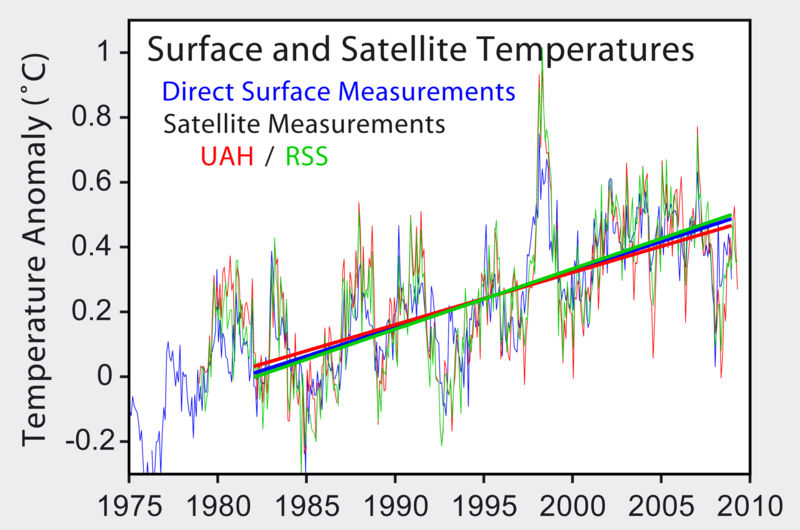
So, Al Gore's wrong, but is the world's temperatures rising? Once again, this is a difficult question to answer. Take this absolutely accurate graph. Using a trend line that uses decades to come up with a figure, temperatures on average have risen. But look at this equally accurate graph. If you base the trend line on shorter amounts of time, then yes, temperatures have been going down over the last several years.

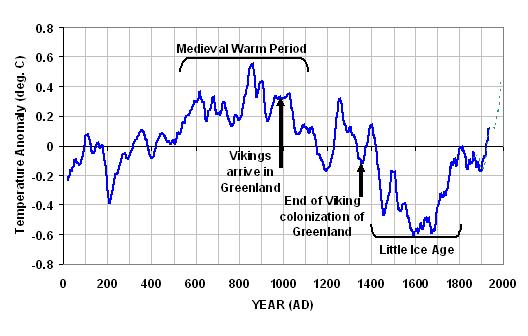
To have perspective, one must look at graphs spanning much longer times. As this graph shows, the recent rise in temperatures looks right at home. Whether it is or not, however, is still up for debate.

Incorrect Arguments From Both Sides

Well, I won't be the first to say this and I won't be the last: people who do not believe in climate change are not evil (necessarily). With data that is as skewed, unknown, and opinionated as this, anyone who says that those against Climate Change are "deniers" are dead wrong. I'm looking at you crazy liberals.

On the other side, those who say that people could not possibly change the environment are also wrong. An explosive example is the testing of the first nuclear weapon... Scientists actually thought that a single bomb could ignite the atmosphere. That would raise world temperature more than half a degree or two. With 6.5 Billion people on earth, we can change anything we want.

Well, that's it for part one. Please stay tuned for part, two, where I will cover Climate Gate, intense weather, and CO2.

Bookmark our site!
Subscribe
Bookmark and Share
Consider advertising on our site!

Monday, December 7, 2009

Copenhagen Conference Heating the Globe

Looks like the global warming conference in Copenhagen may in fact be causing more heating than its solving. According to the British Telegraph, the effects of the delegates arriving are causing warming by the following:

As well 15,000 delegates and officials, 5,000 journalists and 98 world leaders, the Danish capital will be blessed by the presence of Leonardo DiCaprio, Daryl Hannah, Helena Christensen, Archbishop Desmond Tutu and Prince Charles. A Republican US senator, Jim Inhofe, is jetting in at the head of an anti-climate-change "Truth Squad." The top hotels – all fully booked at £650 a night – are readying their Climate Convention menus of (no doubt sustainable) scallops, foie gras and sculpted caviar wedges.


Bookmark our site!
Subscribe
Bookmark and Share
Consider advertising on our site!

Tuesday, December 1, 2009

UN on Climategate: Uhhhhhh

The UN has apparently had something to say about the growing scandal about global warming data. Leaks have placed great doubt on the scientific "consensus" that unchecked, global warming will kill us all.

Even though leaked emails have shown that even many of the environmental scientists are fudging the numbers about warming, thew UN won't take them into account.

But of course, there won't be bias because of peer review. Peer review is an excellent tool to weed out incompetence, unless of course, everyone agrees on something:

Pachauri said the large number of contributors and rigorous peer review mechanism adopted by the IPCC meant that any bias would be rapidly uncovered.

"The processes in the IPCC are so robust, so inclusive, that even if an author or two has a particular bias it is completely unlikely that bias will find its way into the IPCC report," he said.

Well, that's reassuring.

Bookmark our site!
Subscribe
Bookmark and Share
Consider advertising on our site!

Tuesday, November 24, 2009

The "Global Warning Hoax"

With the release of formerly secret documents from a global warming thinktank, accusations of a great global warming fraud are permeating the internets. Take a look:

CBS News:

A few days after leaked e-mail messages appeared on the Internet, the U.S. Congress may probe whether prominent scientists who are advocates of global warming theories misrepresented the truth about climate change.

Sen. James Inhofe, an Oklahoma Republican, said on Monday the leaked correspondence suggested researchers "cooked the science to make this thing look as if the science was settled, when all the time of course we knew it was not," according to a transcript of a radio interview posted on his Web site. Aides for Rep. Darrell Issa, a California Republican, are also looking into the disclosure.

The leaked documents (see our previous coverage) come from the Climatic Research Unit of the University of East Anglia in eastern England. In global warming circles, the CRU wields outsize influence: it claims the world's largest temperature data set, and its work and mathematical models were incorporated into the United Nations Intergovernmental Panel on Climate Change's 2007 report. That report, in turn, is what the Environmental Protection Agency acknowledged it "relies on most heavily" when concluding that carbon dioxide emissions endanger public health and should be regulated.

Last week's leaked e-mails range from innocuous to embarrassing and, critics believe, scandalous. They show that some of the field's most prominent scientists were so wedded to theories of man-made global warming that they ridiculed dissenters who asked for copies of their data ("have to respond to more crap criticisms from the idiots"), cheered the deaths of skeptical journalists, and plotted how to keep researchers who reached different conclusions from publishing in peer-reviewed journals.

One e-mail message, apparently from CRU director Phil Jones, references the U.K.'s Freedom of Information Act when asking another researcher to delete correspondence that might be disclosed in response to public records law: "Can you delete any emails you may have had with Keith re AR4? Keith will do likewise." Another, also apparently from Jones: global warming skeptics "have been after the CRU station data for years. If they ever hear there is a Freedom of Information Act now in the UK, I think I'll delete the file rather than send to anyone." (Jones was a contributing author to the chapter of the U.N.'s IPCC report titled "Detection of Climate Change and Attribution of Causes.")

In addition to e-mail messages, the roughly 3,600 leaked documents posted on sites including Wikileaks.org and EastAngliaEmails.com include computer code and a description of how an unfortunate programmer named "Harry" -- possibly the CRU's Ian "Harry" Harris -- was tasked with resuscitating and updating a key temperature database that proved to be problematic. Some excerpts from what appear to be his notes, emphasis added:
I am seriously worried that our flagship gridded data product is produced by Delaunay triangulation - apparently linear as well. As far as I can see, this renders the station counts totally meaningless. It also means that we cannot say exactly how the gridded data is arrived at from a statistical perspective - since we're using an off-the-shelf product that isn't documented sufficiently to say that. Why this wasn't coded up in Fortran I don't know - time pressures perhaps? Was too much effort expended on homogenisation, that there wasn't enough time to write a gridding procedure? Of course, it's too late for me to fix it too. Meh.

I am very sorry to report that the rest of the databases seem to be in nearly as poor a state as Australia was. There are hundreds if not thousands of pairs of dummy stations, one with no WMO and one with, usually overlapping and with the same station name and very similar coordinates. I know it could be old and new stations, but why such large overlaps if that's the case? Aarrggghhh! There truly is no end in sight... So, we can have a proper result, but only by including a load of garbage!

One thing that's unsettling is that many of the assigned WMo codes for Canadian stations do not return any hits with a web search. Usually the country's met office, or at least the Weather Underground, show up – but for these stations, nothing at all. Makes me wonder if these are long-discontinued, or were even invented somewhere other than Canada!

Knowing how long it takes to debug this suite - the experiment endeth here. The option (like all the anomdtb options) is totally undocumented so we'll never know what we lost. 22. Right, time to stop pussyfooting around the niceties of Tim's labyrinthine software suites - let's have a go at producing CRU TS 3.0! since failing to do that will be the definitive failure of the entire project.

Ulp! I am seriously close to giving up, again. The history of this is so complex that I can't get far enough into it before by head hurts and I have to stop. Each parameter has a tortuous history of manual and semi-automated interventions that I simply cannot just go back to early versions and run the update prog. I could be throwing away all kinds of corrections - to lat/lons, to WMOs (yes!), and more. So what the hell can I do about all these duplicate stations?...

As the leaked messages, and especially the HARRY_READ_ME.txt file, found their way around technical circles, two things happened: first, programmers unaffiliated with East Anglia started taking a close look at the quality of the CRU's code, and second, they began to feel sympathetic for anyone who had to spend three years (including working weekends) trying to make sense of code that appeared to be undocumented and buggy, while representing the core of CRU's climate model.

One programmer highlighted the error of relying on computer code that, if it generates an error message, continues as if nothing untoward ever occurred. Another debugged the code by pointing out why the output of a calculation that should always generate a positive number was incorrectly generating a negative one. A third concluded: "I feel for this guy. He's obviously spent years trying to get data from undocumented and completely messy sources."

Programmer-written comments inserted into CRU's Fortran code have drawn fire as well. The file briffa_sep98_d.pro says: "Apply a VERY ARTIFICAL correction for decline!!" and "APPLY ARTIFICIAL CORRECTION." Another, quantify_tsdcal.pro, says: "Low pass filtering at century and longer time scales never gets rid of the trend - so eventually I start to scale down the 120-yr low pass time series to mimic the effect of removing/adding longer time scales!"

It's not clear how the files were leaked. One theory says that a malicious hacker slipped into East Anglia's network and snatched thousands of documents. Another says that the files had already been assembled in response to a Freedom of Information request and, immediately after it was denied, a whistleblower decided to disclose them. (Lending credence to that theory is the fact that no personal e-mail messages unrelated to climate change appear to have been leaked.)

For its part, the University of East Anglia has posted a statement calling the disclosure "mischievous" and saying it is aiding the police in an investigation.

The statement also quotes Jones, CRU's director, explaining his November 1999 e-mail, which said: "I've just completed Mike's Nature trick of adding in the real temps to each series for the last 20 years (ie from 1981 onwards) amd from 1961 for Keith's to hide the decline." Jones said that the word trick was used "colloquially as in a clever thing to do" and that it "is ludicrous to suggest that it refers to anything untoward."

Also unclear is the ultimate impact of the leak, which came before next month's Copenhagen summit and Democratic plans for cap and trade legislation.

On one hand, over at RealClimate.org, Gavin Schmidt, a modeler for the NASA Goddard Institute for Space Studies, has been downplaying the leak. Schmidt wrote: "There is no evidence of any worldwide conspiracy, no mention of George Soros nefariously funding climate research ... no admission that global warming is a hoax, no evidence of the falsifying of data, and no 'marching orders' from our socialist/communist/vegetarian overlords."

On the other, groups like the free-market Competitive Enterprise Institute, the target of repeated derision in the leaked e-mails, have said: "We have argued for many years that much of the scientific case for global warming alarmism was weak and some of it was phony. It now looks like a lot of it may be phony."

ScienceMag.org published an article noting that deleting e-mail messages to hide them from a FOI request is a crime in the United Kingdom. George Monbiot, a U.K. activist and journalist who previously called for dramatic action to deal with global warming, wrote: "It's no use pretending that this isn't a major blow. The emails extracted by a hacker from the climatic research unit at the University of East Anglia could scarcely be more damaging."

Complicating matters for congressional Republicans who'd like to hold hearings is that East Anglia, of course, is a U.K. university. The GOP may intend to press the Obama administration for details on how the EPA came to rely on the CRU's predictions, and whether the recent disclosure will change the agency's position. Another approach lies in e-mail messages discussing grants from the U.S. Commerce Department's National Oceanic and Atmospheric Administration to East Anglia; one says: "We need to show some left to cover the costs of the trip Roger didn't make and also the fees/equipment/computer money we haven't spent otherwise NOAA will be suspicious."

The irony of this situation is that most of us expect science to be conducted in the open, without unpublished secret data, hidden agendas, and computer programs of dubious reliability. East Anglia's Climatic Research Unit might have avoided this snafu by publicly disclosing as much as possible at every step of the way.
Bookmark our site!
Subscribe
Bookmark and Share
Consider advertising on our site!

Wednesday, March 11, 2009

Gallup: 41% Say Global Warming "Exaggerated"

An increasing amount of Americans are skeptical of all of the talk about global warming. While I may personally believe it may be happening, all of the hooplah is out of control, with Al Gore more in love with Al Gore than Miami-Dade county in November 2000.

As recently as 2006, significantly more Americans thought the news underestimated the seriousness of global warming than said it exaggerated it, 38% vs. 30%. Now, according to Gallup's 2009 Environment survey, more Americans say the problem is exaggerated rather than underestimated, 41% vs. 28%.

The trend in the "exaggerated" response has been somewhat volatile since 2001, and the previous high point, 38%, came in 2004. Over the next two years, "exaggerated" sentiment fell to 31% and 30%. Still, as noted, the current 41% is the highest since Gallup's trend on this measure began in 1997.


Consider advertising on our site!
Also, if you need to search anything on Google, please use the bar below:

Friday, March 6, 2009

Global Warming might be on hold, study finds

From MSNBC (of all places):

"For those who have endured this winter's frigid temperatures and today's heavy snowstorm in the Northeast, the concept of global warming may seem, well, almost wishful.

But climate is known to be variable — a cold winter, or a few strung together doesn't mean the planet is cooling. Still, according to a new study, global warming may have hit a speed bump and could go into hiding for decades.

Earth's climate continues to confound scientists. Following a 30-year trend of warming, global temperatures have flatlined since 2001 despite rising greenhouse gas concentrations, and a heat surplus that should have cranked up the planetary thermostat.

"This is nothing like anything we've seen since 1950," Kyle Swanson of the University of Wisconsin-Milwaukee said. "Cooling events since then had firm causes, like eruptions or large-magnitude La Ninas. This current cooling doesn't have one."

Instead, Swanson and colleague Anastasios Tsonis think a series of climate processes have aligned, conspiring to chill the climate. In 1997 and 1998, the tropical Pacific Ocean warmed rapidly in what Swanson called a "super El Nino event." It sent a shock wave through the oceans and atmosphere, jarring their circulation patterns into unison.

How does this square with temperature records from 2005-2007, by some measurements among the warmest years on record? When added up with the other four years since 2001, Swanson said the overall trend is flat, even though temperatures should have gone up by 0.2 degrees Centigrade (0.36 degrees Fahrenheit) during that time.

The discrepancy gets to the heart of one of the toughest problems in climate science — identifying the difference between natural variability (like the occasional March snow storm) from human-induced change.

But just what's causing the cooling is a mystery. Sinking water currents in the north Atlantic Ocean could be sucking heat down into the depths. Or an overabundance of tropical clouds may be reflecting more of the sun's energy than usual back out into space.

"It is possible that a fraction of the most recent rapid warming since the 1970's was due to a free variation in climate," Isaac Held of the National Oceanic and Atmospheric Administration in Princeton, New Jersey wrote in an email to Discovery News. "Suggesting that the warming might possibly slow down or even stagnate for a few years before rapid warming commences again."

Swanson thinks the trend could continue for up to 30 years. But he warned that it's just a hiccup, and that humans' penchant for spewing greenhouse gases will certainly come back to haunt us.

"When the climate kicks back out of this state, we'll have explosive warming," Swanson said. "Thirty years of greenhouse gas radiative forcing will still be there and then bang, the warming will return and be very aggressive.""


Consider advertising on our site!
Also, if you need to search anything on Google, please use the bar below:

Wednesday, January 28, 2009

Solution to Global Warming: Dumping Iron into the Ocean

Well, no matter if global warming is man-made or not, we may want to be careful about some... extreme measures. A country like Germany, not known for extremes, is pushing one really strange option. Dumping iron into the sea!

Dumping iron in the ocean to reverse global warming evokes strong reactions and epitomizes the political hot potato. The German government lead resistance to attempts to use the fertilization of plankton growth in oceans for commercially offsetting greenhouse gas emissions, ultimately promoting an international convention restricting iron fertilization. The irony was not lost on many when Germany's own Alfred Wegener Institute announced plans for a large scientific study of iron fertilization. And this potato got so hot, the German science ministry suspended approval for the experiment pending further analysis -- even as the research ship Polarstern cruised toward the planned destination for the iron dump.

Independent Review of Ocean Fertilization Study
Independent reviews of the study were evaluated by both the Federal Ministry of Education and Research and the Federal Ministry for the Environment, Nature Conservation and Nuclear Safety. The reviews affirmed the green light for the project. "After careful study of expert reports, I am convinced there are no scientific or legal objections to the German-Indian marine research project," said Science Minister Annette Schavan, as quoted at The Earth Times.

Sunday, December 28, 2008

Global Warming Dooming Us All

Now, me and Mike are environmentalist Republicans, supporters of windmills, biofuels, hydro power, and nuclear power. However, I have to say that this is perhaps too far--

So here's some things that we're going to die from. A lot of direct pasting, but I think it's worth it:

1. Cannibalism

In April, media mogul Ted Turner told PBS's Charlie Rose that global warming would make the world 8 degrees hotter in 30 or 40 years. "Civilization will have broken down. The few people left will be living in a failed state, like Somalia or Sudan, and living conditions will be intolerable," he said.

Turner blamed global warming on overpopulation, saying "too many people are using too much stuff."

Crops won't grow and "most of the people will have died and the rest of us will be cannibals," Turner said.

2. The Death of the Loch Ness Monster

In February, Scotland's Daily Mirror reported that 85-year-old American Robert Rines would be giving up his quest for Scotland's most famous underwater denizen.

A World War II veteran, Rines has spent 37 years hunting for Nessie with sonar equipment. In 2008, "despite having hundreds of sonar contacts over the years, the trail has since gone cold and Rines believes that Nessie may be dead, a victim of global warming."

3. Beer Gets More Expensive

In April, the Associated Press reported that global warming was going to hit beer drinkers in the wallet because the cost of barley would increase, driving up the price of a pint.

Jim Salinger, a climate scientist at New Zealand's National Institute of Water and Atmospheric Research, said Australia would be particularly hard hit as droughts caused a decline in malting barley production in parts of New Zealand and Australia. "It will mean either there will be pubs without beer or the cost of beer will go up," Salinger said at a beer brewer's convention, the AP reported.

4. Pythons Take Over America

Giant Burmese pythons – big enough to eat alligators and deer in a single mouthful – will be capable of living in one-third of continental U.S. as global warming makes more of the country hospitable to the cold-blooded predators, according to an April report from USAToday.com.

The U.S. Geological Survey and the Fish and Wildlife Service investigated the spread of "invasive snakes," like the pythons, brought to the U.S. as pets. The Burmese pythons' potential American habitat would expand by 2100, according to global warming models, the paper reported.

"We were surprised by the map. It was bigger than we thought it was going to be," says Gordon Rodda, zoologist and lead project researcher, told USAToday.com. "They are moving northward, there's no question."

5. Kidney Stones

A University of Texas study said global warming will cause an increase in kidney stones over the next 30 years, the Globe and Mail reported in July.

Scientists predict that higher temperatures will lead to more dehydration and therefore to more kidney stones. "This will come and get you in your home," said Dr. Tom Brikowski, lead researcher and an associate professor at the University of Texas at Dallas. "It will make life just uncomfortable enough that maybe people will slow down and think what they're doing to the climate."

6. Skinny Whales

Japanese scientists, who have claimed that the country's controversial whaling program is all in the name of science, said in August that if they hadn't been going around killing whales, they never would have discovered that the creatures were significantly skinnier than whales killed in the late 1980s, the Guardian reported in August.

The researchers said the study was the first evidence that global warming was harming whales by restricting their food supplies. As water warmed around the Antarctic Peninsula, the krill population shrank by 80 percent as sea ice declined, eliminating much of the preferred food of the minke whale.

The whales studied had lost the same amount of blubber as they would have by starving for 36 days, but the global warming connection couldn't be proven because no krill measurements are taken in different regions.

7. Shark Attacks

A surge in fatal shark attacks was the handiwork of global warming, according to a report in the Guardian in May.

George Burgess of Florida University, a shark expert that maintains an attack database, told the Guardian that shark attacks were caused by human activity. "As the population continues to rise, so does the number of people in the water for recreation. And as long as we have an increase in human hours in the water, we will have an increase in shark bites," he said.

Shark attacks could also be the result of global warming and rising sea temperatures, the Guardian said. "You'll find that some species will begin to appear in places they didn't in the past with some regularity," Burgess said.

8. Black Hawk Down

Although it happened in 1993, the crash of a U.S. military helicopter in Mogadishu that became the film "Black Hawk Down" was blamed on global warming by a Massachusetts congressman in 2008.

"In Somalia back in 1993, climate change, according to 11 three- and four-star generals, resulted in a drought which led to famine,” Rep. Edward Markey told a group of students who had come to the Capitol to discuss global warming, according to CNSNews.com. "That famine translated to international aid we sent in to Somalia, which then led to the U.S. having to send in forces to separate all the groups that were fighting over the aid, which led to Black Hawk Down."

9. Frozen Penguin Babies

Penguin babies, whose water-repellant feathers had not grown in yet, froze to death after torrential rains, National Geographic reported in July.

"Many, many, many of them—thousands of them—were dying," explorer Jon Bowermaster told National Geographic. Witnessing the mass penguin death "painted a clear and grim picture" of global warming.

"It's not just melting ice," Bowermaster said. "It's actually killing these cute little birds that are so popular in the movies."

10. Killer Stingray Invasion

Global warming is going to drive killer stingrays, like the one that killed Crocodile Hunter Steve Irwin, to the shores of Britain after a 5-foot -long marbled stingray was captured by fishermen, the Daily Mail reported in June.

A single touch can zap a man with enough electricity to kill, the Mail said, and global warming is bringing the Mediterranean killers north.

"Rising sea temperatures may well have brought an influx of warm water visitors," sea life curator Alex Gerrard told the Mail. "Where there's one electric ray, it's quite likely that there are more."

How about that?